Quick Read
- Pickup Coffee reported more than 500 company-owned stores before it formally opened franchising in April 2026, and management wants franchised units to stay below 20% to 25% of the system.
- Franchise vs company-owned stores decides who pays for each new outlet, either Pickup and its investors or a franchisee putting in ₱1.7 million to ₱4 million.
- The 18 to 24 month payback Pickup cites is its own estimate under ideal conditions, so the franchisee carries the gap if sales disappoint.
- No source ties Pickup’s franchise timing to Compose Coffee or ZUS, and Compose’s franchise-led entry matches how that brand already runs in South Korea.
- Pickup approves sites through its own internal model for both store types, so franchisees fund the store without the final say on where it goes.
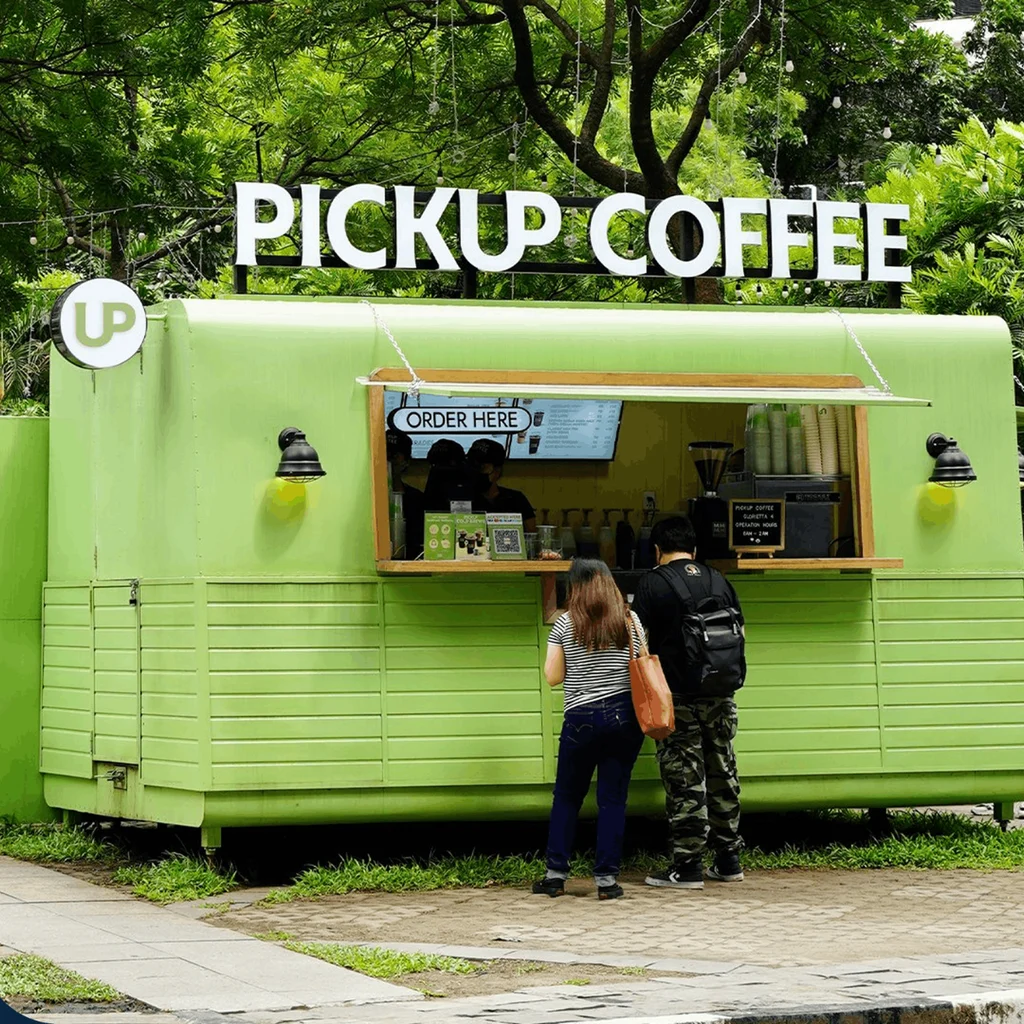
Pickup Coffee spent its first four years building more than 500 company-owned stores, then formally opened franchising in April 2026. The easy reading is that Jollibee’s Compose Coffee forced the move, but no source says so. What the record does show is a change in who pays for the next store, and franchise vs company-owned stores is the comparison that explains it.
Pickup Popularized a Low-Cost Takeout Format
Pickup Coffee launched in 2022 as a grab-and-go chain built on small stands, minimal seating, and espresso drinks starting at ₱50. Its app lets customers order and pay ahead. Management says the small footprint and reduced air-conditioning keep costs low enough to hold prices.
That format shapes the economics of everything that follows. A cart or kiosk costs far less to build than a café, which helps explain why Pickup can quote ₱1.7 million for a kiosk franchise and why it could open hundreds of company-owned units in four years.
Pickup did not create this market alone. ZUS Coffee entered the Philippines in 2023 with an app-first, low-price model, and a 2025 report on the Malaysian chain said roughly 70% of its sales came through delivery and pickup, though it did not name the market. ZUS says on its website that it has no franchise model, though that page does not specify the market either. Compose Coffee competes in the same value segment. Pickup is also adding a larger format with seating, so even its own version of the category is widening.
Investors Funded the Company-Owned Phase
Pickup’s first 500 stores were company-owned, and venture capital sat behind the company. A Series A1 round in April 2023, led by Go-Ventures, was reported at $40 million in one account that cited company confirmation and at $26.7 million in another that counted regulatory filings. In March 2026, a report citing people familiar with the matter said Pickup was seeking up to $8 million in convertible notes from Venturi Partners and Antler. The report relied on those sources rather than a company statement.
The sequence matters but proves little. At its fourth anniversary on March 19, within a week of that funding report, Pickup said franchising was coming soon. Executives also said company-owned openings would continue. The timing fits a company that wants a second source of expansion capital. It also fits a company that had always planned to franchise once the format was proven. No public statement says which.
Franchise vs Company-Owned Stores Split the Funding and the Risk
Franchise vs company-owned stores puts different parties on the hook. In a company-owned store, Pickup and its investors fund the build, absorb a slow ramp, and keep the sales. In a franchise, the franchisee pays for the cart or kiosk and takes the early losses if sales lag, while Pickup keeps the brand, the supply chain, and a say over where the store goes.
| Model | Who funds the store | Who approves the site | Return claim |
|---|---|---|---|
| Pickup company-owned | Pickup and its investors | Pickup’s internal model | None published |
| Pickup franchise | Franchisee, ₱1.7 million to ₱4 million | Pickup’s same model | 18 to 24 months, company estimate |
| Compose Philippines | Franchisees, under a master franchise held by a Jollibee subsidiary | Not disclosed | Not disclosed |
| ZUS Philippines | ZUS, with a Filipino restaurant group holding 35% of the parent | Not disclosed | Not disclosed |
The Pickup Coffee franchise costs ₱1.7 million to ₱4 million by format, covering the franchise fee, construction, equipment, and starting inventory. It projects a payback period of 18 to 24 months and says in its own announcement that the figure rests on internal estimates and ideal conditions. Pickup says franchisees also get centralized supply chain support, training, technology integration, and site evaluation. Management says franchisee profitability is the priority, but the public materials give no store-level sales or franchisee return figures.
The Cap Keeps Control With the Franchisor
Management wants the mix of franchise vs company-owned stores to stay lopsided, with franchised outlets below 20% to 25% of the system, which keeps the core network company-operated. Site approval runs through the same internal model for both store types, and the company says that model replaced fixed distance rules. Franchisees therefore take the capital risk without the final say on the site.

Whether a franchisee gets protection from a nearby company-owned store is not stated in the public materials. The same model that approves a franchise cart could approve a company-owned one down the street, and any rule against that has not been published. The 800-store year-end goal adds a second unknown. One report quotes management saying franchised units sit outside that target, while another describes the remaining expansion as coming from franchisees. The two readings imply different company-owned store counts.
Jollibee Starts With Franchising Because Compose Already Runs on It
Compose Coffee had about 2,470 franchised stores when Jollibee agreed in July 2024 to pay $238 million for 70% of the company, in a deal valuing it at $340 million. The chain now runs more than 3,000 stores, mostly in South Korea. Jollibee’s subsidiary, Fresh N’ Famous Foods, signed a master franchise agreement for the Philippines in February 2026, and the first Compose Coffee Philippines store opened on August 7 at Market! Market! in Taguig under franchisee Jeannie Posas. Jollibee has set a five-year goal of making the Philippines Compose’s largest market outside South Korea.
That is a franchise-first entry, but it is also how the brand already works. Nothing in the record shows Compose chose franchising to answer Pickup. Jollibee said in July 2024 that it had no plan to bring Compose to the Philippines, and it reversed that position in February 2026. The terms of the master franchise were not disclosed. Jollibee sits on both sides of it as majority owner of the brand and parent of the master franchisee, so any fees or royalties between the two are not visible.
Jollibee is not spending without limits either. It cut its 2026 store-opening target by 200 stores, to 1,000 to 1,100 new locations, as softer sales at existing outlets and cost pressure tempered its outlook, according to a report on its second-quarter results. Both companies are managing the cost of expansion, not simply buying sites.
The Reason Pickup Shifted Remains Unconfirmed
Four explanations circulate, and the record supports them unevenly.
The first is Pickup’s own. Executives call franchising a strategic step to accelerate expansion, and they say the company spent years refining operations across 500 company-owned stores before offering the model to others. That is documented but self-reported.
The second is cost caution. Management said it initially wanted 750 to 800 stores this year and is now being more careful given the situation in the Middle East, while saying coffee demand has stayed stable despite higher commodity prices.
The third is funding, covered above. The fourth is competition from Compose and ZUS. The timing allows it, since Pickup said franchising was coming about a month after Jollibee announced the Compose master franchise. But Pickup has not publicly said competition played a role, and the same sequence fits a plan made before Compose’s announcement.
The popular claim holds that the race is for locations. That is a hypothesis. On the record are narrower facts. Across franchise vs company-owned stores, Pickup controls site approval whether it or a franchisee pays, and both Pickup and Compose now rely on franchisee money for part of their growth. The change in who pays is documented. The location race is not.
Franchisees Carry the Payback Risk Until 2028
Franchise vs company-owned stores comes down to who holds the cost of the next Pickup store, and franchising puts it on the person who buys the cart. Pickup keeps the brand, the supply chain, and the final say on the site, and it limits how much of the next store count its own balance sheet must fund. If payback runs past 24 months, the franchisee carries the delay, not the company that approved the site and projected the payback. Franchises opened this year reach the end of that window in 2028, and until then the only returns on record are the ones the company projected.

PICKUP COFFEE is Now Open for Franchising, Pickup Coffee, 2026
Stay ahead of the cost structures, capital flows, and market recalibrations that shape Philippine business in Business & Money section of Hemos PH.