Quick Read
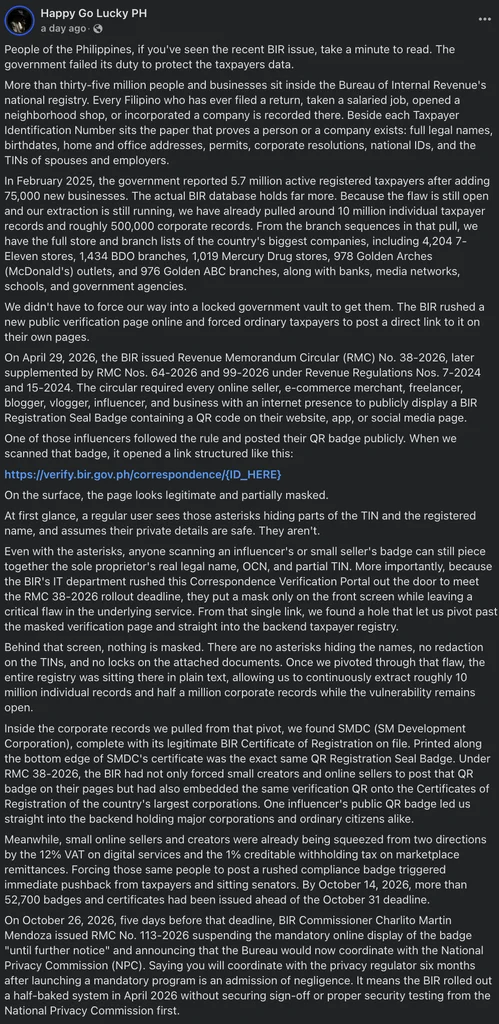
- A group calling itself Happy Go Lucky PH claims it pulled about 10 million individual and 500,000 corporate taxpayer records, and the BIR has not confirmed any BIR data breach.
- The BIR says it is investigating with the DICT and anti-cybercrime units, and the NPC has said an allegation alone does not establish a breach.
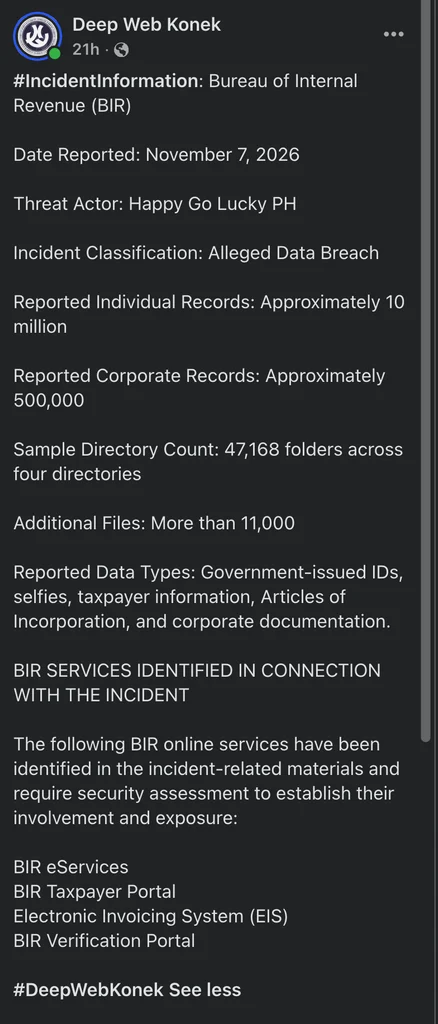
- The actor lists government-issued IDs, taxpayer information, and corporate documents among the data, which would put the NPC’s 72-hour notification rule in play if confirmed.
- RMC 38-2026 required online sellers and creators to post a public QR badge linked to a BIR verification page, and RMC 113-2026 suspended that requirement on October 26.
- Sellers who already posted badges carry the risk, because the suspension made display optional and did not undo what was published.
A BIR data breach has been claimed but not confirmed. The group calling itself Happy Go Lucky PH says it pulled about 10 million individual and 500,000 corporate taxpayer records, and says the route ran through the verification system behind the BIR’s Registration Seal Badge. The BIR has said only that it is investigating.
Between the claim and any confirmation, taxpayers are left to decide how much to assume. What follows separates what is on record from what is alleged, then makes two arguments. The first is the obvious one about public trust in digital compliance. The second is about who carries the cost of the badge rule.
The BIR Data Breach Claim Is Still Only a Claim
The actor’s own statement, and reports relaying it, put the figures at about 10 million individual records and about 500,000 corporate records. Those reports list government-issued IDs, selfies, taxpayer information, Articles of Incorporation, and other corporate documents among the data. No independent verification of the samples has been reported, and none of the figures comes from the BIR.

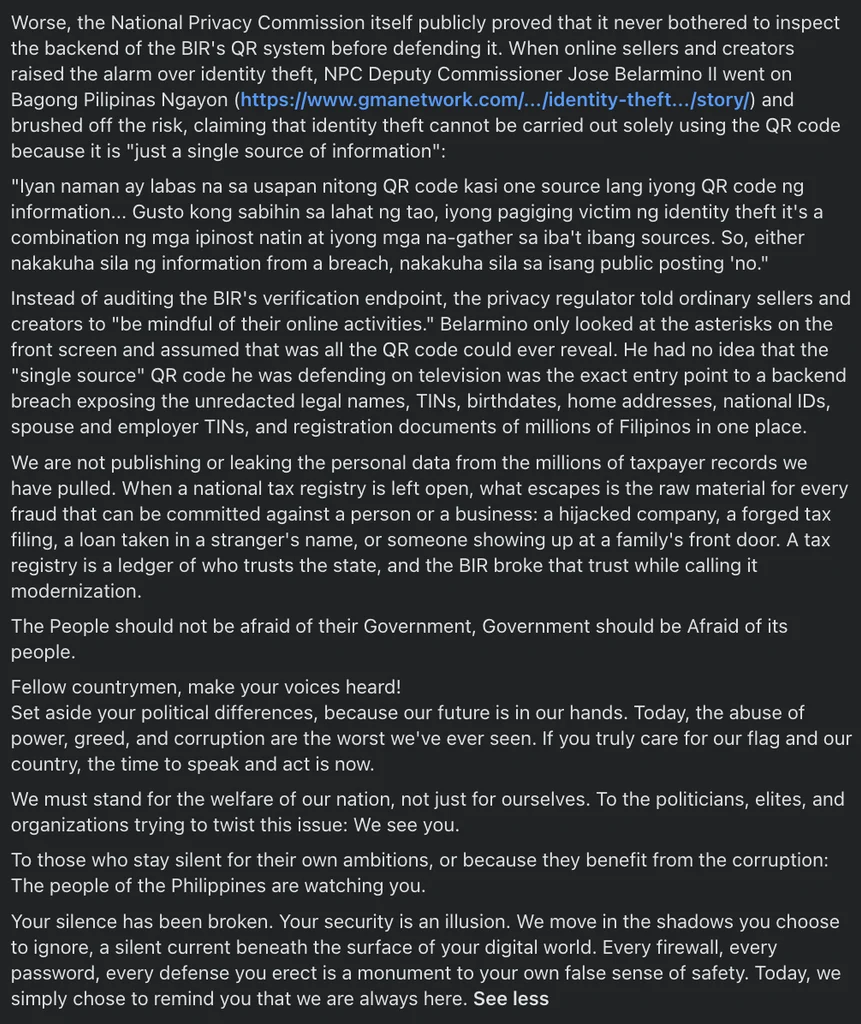
The statement is also political in tone. It accuses the government of failing taxpayers and calls on the public to speak up. That framing belongs to the group, and it is not evidence of what was reached.
In an advisory reported on November 7, the BIR said it is aware of online reports of an alleged leak of data claimed to be associated with the agency. It said it is working with the DICT, the National Computer Emergency Response Team, the Cybercrime Investigation and Coordinating Center, and the PNP Anti-Cybercrime Group, and is treating the claims as an urgent priority. It did not say how much data or what kind might be involved. As reported, the advisory names no actor, so it cannot be tied to this specific claim.
The NPC said on November 6, in a statement on a wider run of alleged agency leaks, that it had received no personal-data breach notifications from the agencies concerned. It added that an allegation alone does not establish that a breach occurred. Whether the BIR has since filed a notification has not been reported.
Confirmation Would Put Public Trust in Digital Filing on Trial
If the claim holds, the data types matter more than the count. Government-issued IDs, selfies, and taxpayer details are the material identity fraud runs on, and corporate documents give a fraudster what is needed to pass as a business. Anyone registered with the BIR would have to assume their records are out before any official count exists.

A confirmed BIR data breach would also start a legal clock. Under NPC Circular 16-03, which the NPC supplemented with an advisory as recently as May, a personal information controller must notify the NPC and affected individuals of a reportable breach within 72 hours of knowing, or reasonably believing, that it occurred. Government agencies are covered. Whether a notification is filed becomes a checkable fact long before any forensic report is public.
The wider point is about trust in the systems that collect taxpayer data. Digital filing, e-invoicing, and online registration all depend on taxpayers handing data to the BIR. A confirmed breach would put a price on that dependence. Even an unconfirmed claim of this size forces the question, since the BIR has not yet said what, if anything, was reached. On September 8, the BIR reported a brief website defacement and said its initial assessment found no effect on taxpayer information or core systems. It has not linked that incident to the current claim.
The Badge Mandate Put the Risk on Small Sellers
On April 29, the BIR issued RMC 38-2026, requiring online sellers, e-commerce merchants, digital service providers, freelancers, vloggers, and content creators to post a BIR Registration Seal Badge on their pages. The badge was introduced as an alternative to posting the full Certificate of Registration online. Scanning it shows the registered name and masked digits of the Tax Identification Number. By October 14, more than 52,700 registration certificates carrying the badge had been secured, according to the BIR.

The cost of that rule landed on the smallest taxpayers. A sole proprietor selling through social media had to secure the badge, post it, and keep it public. The seller carried the posting, and the BIR held the system behind the link.
Concerns came before any public BIR data breach claim. Senators Bam Aquino and Pia Cayetano pressed the BIR over privacy, with Aquino calling for a suspension before the deadline, and sellers worried the QR code could reveal full legal names. NPC Deputy Commissioner Jose Belarmino II said identity theft cannot be carried out from the QR code alone, because it is one source among many that a fraudster combines. That remark concerned what the QR code displays. The actor’s claim concerns what sits behind it. The two are different questions.
The Suspension Stops New Postings and Recalls Nothing
On October 26, RMC 113-2026 suspended the mandatory display and the October 31 deadline until further notice. No penalties apply for non-display during the suspension, and sellers who already secured a badge may keep displaying it. Commissioner Charlito Martin Mendoza said the pause lets the BIR address privacy and technical concerns and review the requirement.

The suspension made display optional and left each seller to decide whether to take a badge down. If a BIR data breach is confirmed, the loss falls on the taxpayers whose records were reached, and the 72-hour notification clock starts. If the claim is rebutted, small sellers still hold a public badge tied to a program that is suspended and under review. What the BIR says next decides which of those follows.
More developments that reshape the operating environment in National Signal section of Hemos PH.