Quick Read
- The ASEAN Summit 2026 updates start with the ASEAN Digital Economy Framework Agreement (DEFA), the first region-wide digital economy agreement, signed in Manila on November 14 and expected to take effect in early 2027.
- ASEAN and Canada announced the substantial conclusion of their free trade talks on November 15, with signing targeted for 2027.
- ADB’s $13 billion announcement is a target to mobilize public and private financing by 2030, and the release does not say how much ADB itself would lend.
- ASEAN and China will miss the year-end deadline for the South China Sea Code of Conduct, with about 80 percent of the text provisionally agreed.
- No adoption had been announced for the migrant worker recruitment declaration or the critical minerals declaration as of this cutoff.
The ASEAN Summit 2026 updates as of 10 p.m. PHT on November 15, 2026 show one signed agreement with commercial weight, several financing and policy announcements that are still targets, and one missed deadline. The Philippines is hosting as 2026 chair and the meetings run through November 17, so none of this is a final outcome. What follows separates what is signed from what is only pledged, then says what each item means for Filipinos.
Trade and Digital Economy Agreements Sit at Three Different Stages
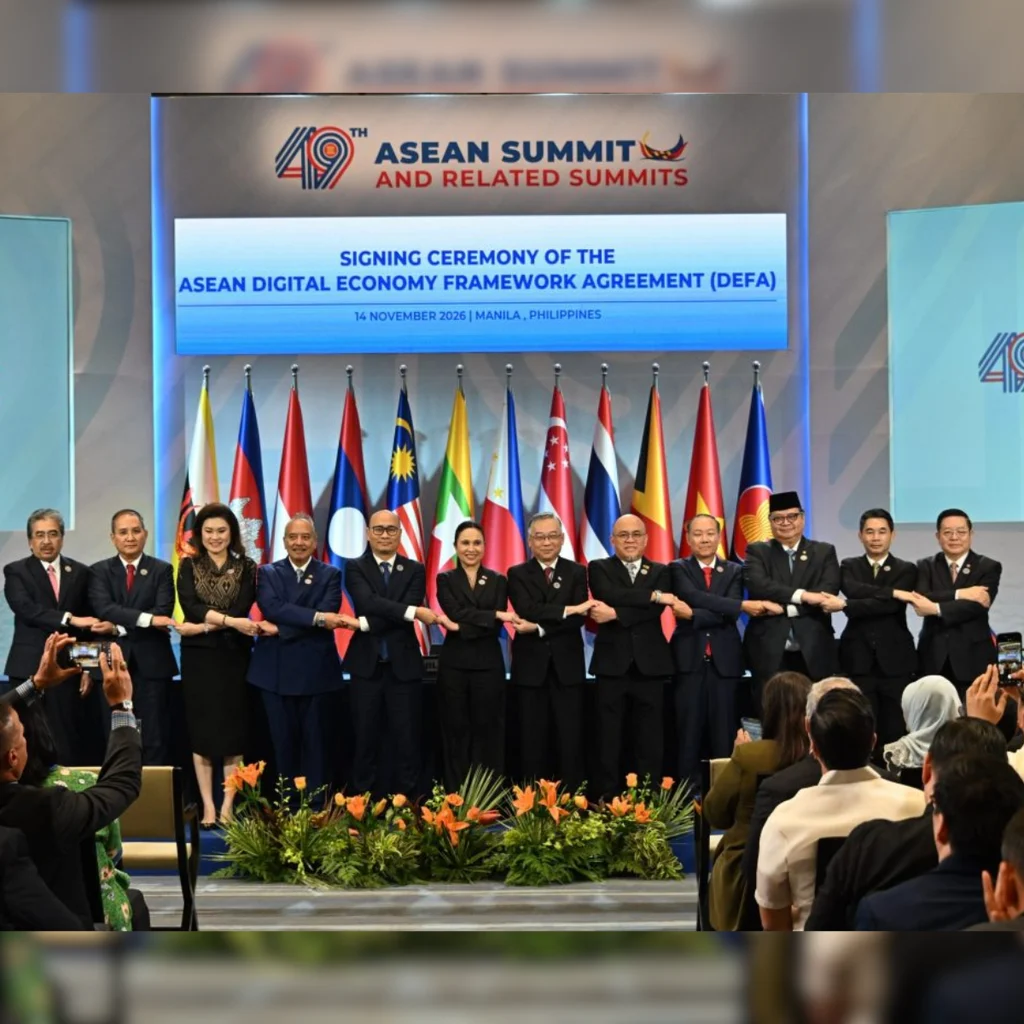
DEFA is the only agreement in this group that has been signed. ASEAN economic ministers signed it in Manila on November 14, led by Trade Secretary Cristina Roque as chair of the ASEAN Economic Community Council, and President Marcos handed the signed copy to ASEAN Secretary-General Kao Kim Hourn on November 15. The agreement sets common rules for digital trade, cross-border payments, and e-commerce, and the Philippine government says it also calls for measures that protect online shoppers from deceptive practices and give them a way to seek redress.
One report puts entry into force in early 2027. Singapore’s prime minister told leaders on November 15 that DEFA is only a first step and that more work remains to link the region’s economies. The Trade Department projects the regional digital economy could double from about $1 trillion to $2 trillion by 2030, a projection and not a commitment.

For Filipino online sellers and small exporters, the practical change is one set of cross-border rules in place of a different rulebook in each market. That change starts when DEFA is in force, so no seller’s costs move this month.
Canada is at a different stage. ASEAN and Canada announced the substantial conclusion of their free trade agreement, called ACAFTA, in a joint statement on November 15. Negotiators still have technical work to finish, and signing is targeted for 2027 to coincide with the 50th anniversary of ASEAN-Canada dialogue relations.
The Philippines-Canada bilateral deal is less clear. On November 14, Marcos and Canadian Prime Minister Mark Carney endorsed a framework committing both countries to pursue a free trade agreement by 2027, according to published reports, while another report says the two sides announced they had concluded negotiations. Neither deal is signed. Philippine exports to Canada were $1.31 billion in 2025, led by copper and refined copper, so which other exporters gain depends on tariff schedules that are not yet signed.

A third track is agriculture. Brazilian President Luiz Inácio Lula da Silva made the first state visit to the Philippines by a sitting Brazilian president on November 14 and 15, and the two governments witnessed agreements on livestock, agriculture, and competition law enforcement. Their terms were not reported. Brazilian reports said Lula would seek to expand exports of coffee, juices, processed foods, pasta, and biscuits, which would compete with Filipino producers if market access follows.
Financing Announcements Are Not Investments or Disbursements
ADB President Masato Kanda announced two initiatives on November 14 at the ASEAN Business and Investment Summit. The ASEAN Resilient Rivers Initiative aims to mobilize up to $8 billion by 2030 for irrigation, flood defenses, and water management across river basins. The ASEAN Regional Platform for AI and Digital Economy targets up to $5 billion for digital infrastructure, cross-border payment systems, verifiable IDs, cybersecurity, and AI readiness, and it is tied to DEFA implementation. Together they complete a $30 billion ADB pledge to ASEAN.
Each figure is a mobilization target for public and private financing. ADB’s release does not say how much would come from ADB and how much from co-financiers or private investors. ADB’s first job is to help governments identify and prepare bankable projects, so the $13 billion is a pipeline goal. Money reaches a Filipino province or utility only after a project is selected, prepared, approved, and financed. ADB also signed a five-year memorandum designating it ASEAN’s main bank, which is a partnership and not funding.

The critical minerals strategy has a similar status. The Philippine government made an ASEAN critical minerals strategy and a leaders’ declaration goals of its chairship, and a regional workshop in Singapore in early September was still drafting the declaration, a regional definition, and an indicative list of critical minerals. No adoption by leaders had been announced at this cutoff. The Philippines already signed its own memorandum with the United States on February 4 to support local processing of critical minerals and rare earths, which points national policy toward processing instead of raw ore exports. An ASEAN text would add a shared definition of which minerals count.
Migrant Worker and Creative Industry Plans Still Need Domestic Follow-Through
ASEAN labor ministers endorsed the ASEAN Declaration on Fair, Ethical, and Sustainable Recruitment for Empowered Migrant Workers in their August joint communique, which describes it as strengthening regional commitment to fair, transparent, and sustainable recruitment. Migrant Workers Secretary Hans Leo Cacdac said before the summit that the text had cleared several levels of ASEAN review and that he hoped leaders would adopt it in Manila, citing the spread of scam hubs.
Under the proposal, member states would be encouraged to strengthen their recruitment systems, share practices, and coordinate on identifying legitimately recruited workers and likely victims. That wording is the language of a political commitment and not an enforceable rule. A Filipino applicant sees no change until recruitment regulators in sending and receiving countries act on it.
The Philippines also wants to host the ASEAN Center of Excellence for Creative Industries, one of its chairship’s priority economic goals. The Trade Department describes it as a hub for policy research, capacity building, and market development. A Philippine business group says ASEAN economic leaders have endorsed it, Indonesia has voiced support, and its structure was still being refined. Benefits for animation studios, music exporters, and other creative businesses are potential until the center has a mandate, a budget, and a location in operation.
Maritime and Regional Decisions Leave Little Finished
ASEAN-Wide Decisions
ASEAN and China will not finish the South China Sea Code of Conduct this year as agreed in 2023, three Southeast Asian diplomats familiar with the talks said on November 11. They said about 80 percent of the paragraphs are provisionally agreed after the final negotiating round last month, and negotiators plan to continue into next year. Published analysis describes open disputes over whether the code is legally binding, its geographic scope, and the role of outside militaries. Manila made the code its top priority as chair, and Singapore takes over the chairmanship next.
The ASEAN Maritime Center is further along on paper. Leaders adopted a declaration on maritime cooperation in Cebu in May that backs a planned center in the Philippines, and Marcos said the idea had broad consensus and is not aimed at any country. He listed illegal fishing, smuggling, and human trafficking among its concerns. One report on November 14 says its creation was approved, with no operating date. A security analyst wrote in June that details were sketchy and that two maritime coordination centers already operate in Singapore.

On Myanmar, leaders on November 15 kept restrictions on its political representation at summits and foreign ministers’ meetings. They also agreed to engage its government in stages, with a return to high-level meetings tied to progress on ASEAN’s peace plan. Timor-Leste joined as the 11th member in 2025, so its presence in Manila is not a new decision.
Bilateral Agreements
The Philippines and Australia signed a statement of intent in August 2025 to pursue a defense cooperation agreement, with signing aimed at 2026. One report says the two governments signed a defense agreement on November 15, but its terms were not reported.
Canada has given the Philippines access to its dark vessel detection program, which supports monitoring of illegal fishing and maritime awareness, since 2023, and the two leaders stressed continued access in a July 2026 joint statement.
What the ASEAN Summit 2026 Updates Mean for Filipinos
The benefits in these ASEAN Summit 2026 updates split into three timings. Immediate means already in effect, potential means likely but unscheduled, and dependent means tied to a step no government has taken yet.
| Group | Item | Where it stands |
|---|---|---|
| Online sellers and exporters | DEFA, ACAFTA, Canada deal | DEFA signed (immediate). Entry into force and 2027 signing (dependent) |
| Workers and OFWs | Recruitment declaration | Leader adoption, then national enforcement (dependent) |
| Consumers and digital users | DEFA redress measures, ADB digital platform | DEFA in force (dependent). Financing target (potential) |
| Farmers and fishing communities | Rivers initiative, Brazil agreements, maritime center | Projects not yet identified (potential). Center operating (dependent) |
| Economic and security interests | Sea code, Australia pact, Canada cooperation | Myanmar restrictions kept (immediate). Sea code unfinished (dependent) |
Online sellers and small exporters gain first, and only after DEFA takes effect. Platforms and payment providers serving cross-border sellers would likely carry the work of meeting common rules. OFWs gain only if the recruitment declaration is adopted and then written into the rules of sending and receiving countries. Online shoppers get the redress measures only after DEFA is in force.
Farmers in flood and drought-prone river basins are the intended beneficiaries of the rivers initiative, which needs projects before it reaches any farm. Brazil’s agreements could widen import competition for livestock and food producers. Fishing communities see no change from the maritime center until it operates, and the unfinished code leaves the sea without the rulebook Manila wanted.

Philippine security interests got process wins, including a leaders’ declaration backing a Manila-hosted center, a reported Australia pact, and continued Canada cooperation. They did not get the code, and the Philippines carries the diplomatic cost of having made it the chair’s top target before the deadline passed.
Remaining Meetings and Follow-Through Steps Run Into 2027
The ASEAN Summit 2026 updates will keep changing through November 17. Published itineraries list the 23rd ASEAN-India Summit and the 21st East Asia Summit on November 16, with Indian Prime Minister Narendra Modi attending and the leaders of South Korea, Japan, and New Zealand due. The ASEAN-US Special Summit is scheduled for November 17 with President Donald Trump, and Russia’s foreign minister is due that day. The Philippines hands the chairmanship to Singapore at the close.
The pending items are specific. Leaders have not been reported adopting the migrant worker or critical minerals declarations. DEFA is expected to take effect in early 2027. ACAFTA and the Philippines-Canada deal head toward signing in 2027. The sea code moves to Singapore’s chairmanship if talks continue next year.

Every item above is a promise until a government spends money, changes a rule, or enforces one. Online sellers are waiting on DEFA to take effect, migrant workers on recruitment rules their own governments must write and police, and farmers in river basins on projects that still have to be identified and financed.
More developments that reshape the operating environment in National Signal section of Hemos PH.