Quick Read
- No Pax Silica agreement was signed during Donald Trump’s visit to Manila, and both governments still aim to sign before year-end.
- The Pax Silica protests drew an estimated 6,000 people by Human Rights Watch’s count, and HRW reports at least 245 arrested or detained, including journalists and farmers.
- The Commission on Human Rights (CHR) says it observed visible injuries, minors in custody, and delayed access to detainees, and is verifying reports of mistreatment.
- The Palace says police were ordered to use maximum tolerance and the Philippine National Police (PNP) say officers were injured, and no court or regulator has made a finding.
- Hub tenants and contractors inherit the scrutiny and an unresolved Aeta land claim if signing proceeds.
Nothing on Pax Silica was signed during Trump’s visit to Manila, and what the visit produced instead was hundreds of detentions. President Ferdinand Marcos Jr. said the agreement was not covered on the trip, and US Ambassador Lee Lipton said there would be no signing. The Pax Silica protests that surrounded the visit now carry an official rights probe, a request for a United Nations investigation, and a land dispute the state’s own agencies have not settled.
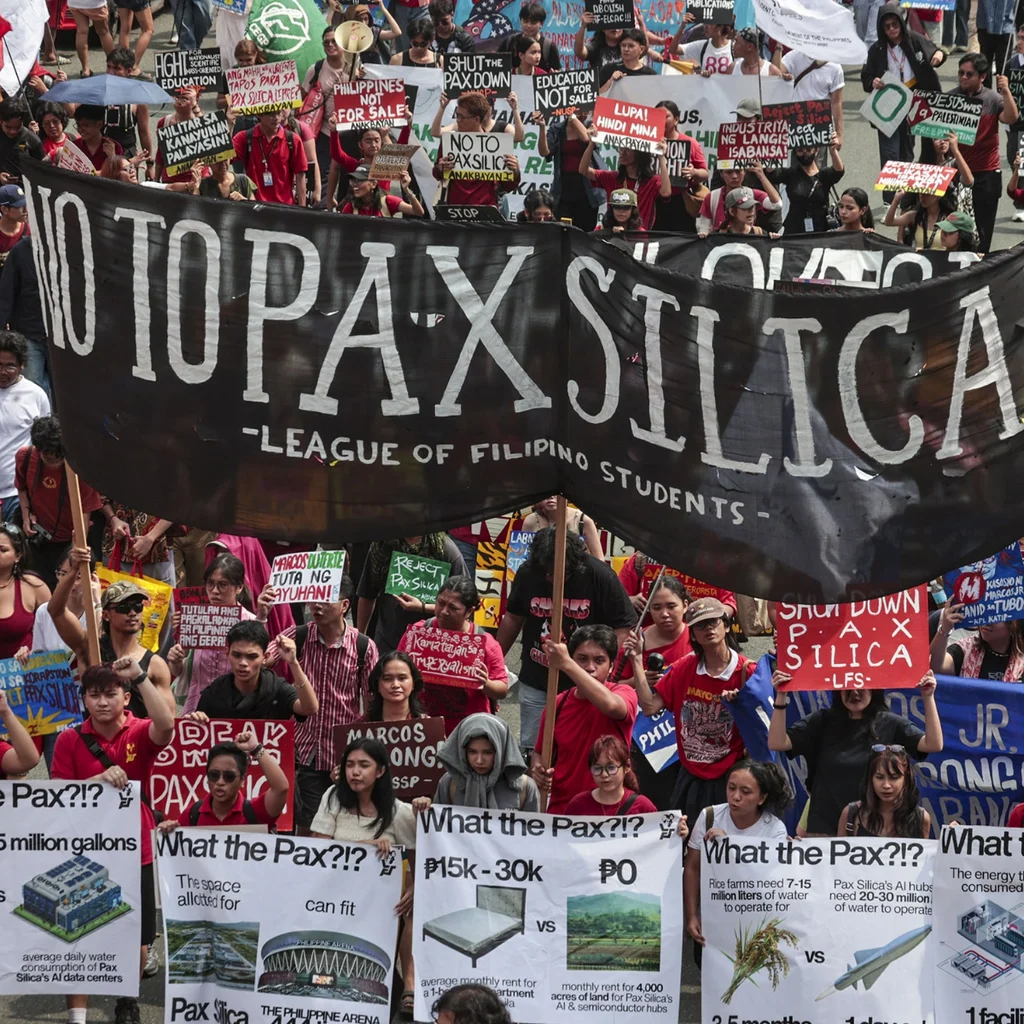
The Pax Silica Protests Ended in Mass Detentions
Student walkouts on November 13 drew thousands nationwide, and marches in Manila ran from November 15 to 18. HRW estimated that 6,000 people joined despite a police ban on demonstrations everywhere except designated freedom parks. According to published reports, the PNP deployed nearly 23,000 personnel across the region.
Arrest figures differ because they count different sites. HRW counted at least 245 people arrested or detained, 236 of them stopped on the outskirts of Metro Manila while traveling from Southern Tagalog and nine at the main protest site. HRW said protesters had been held without charge for three days as of November 18.
| Source | Figure | Site |
|---|---|---|
| HRW | At least 245 arrested or detained | 236 on the outskirts, 9 at the main protest site |
| CHR | 11 apprehended, including one minor | Manila |
| CHR | More than 200 taken into custody, including several minors | Camp Bagong Diwa, after the Muntinlupa protests |
| PNP | More than 200 completed inquest proceedings on November 17 | Metro Manila |
| Cause-oriented groups | About 300 arrested | Metro Manila |
HRW’s breakdown of the 236 includes 29 farmers, among them members of the Indigenous Mangyan tribe, 19 journalists, 9 environmental defenders, and 6 human rights workers. Ephraim Cortez of the National Union of Peoples’ Lawyers said 19 were children. Rights groups also cited restrictions on journalists during the visit. Students were arrested in separate incidents. Three University of Makati students were reportedly arrested in Bonifacio Global City on November 13, and a student was among those taken into custody near Liwasang Bonifacio on November 15.

Protest Video Shows Officers Carrying and Restraining Demonstrators
The Pax Silica protests were driven by fear of displacement and by wider opposition to how the agreement is being carried out. Signs in the footage read “Reject Pax Silica” and “Our land is not for sale.” Farmer groups and Indigenous groups say the planned hub threatens land Aeta communities claim, and BCDA denies the project would displace anyone.
Video from the protests shows officers lifting an older woman off the ground by her arms and legs, and several officers closing around people who are being pulled away from the crowd. A video edit by the group Gulay Na! identifies the woman as a leader of the transport group PISTON at Liwasang Bonifacio. A broadcast clip dated November 15 shows officers surrounding a person on the ground at the same site. Captions on clips posted by cause-oriented groups are those groups’ own claims, and the CHR has not verified them.
Footage from the rights group Karapatan showed a police officer punching a female student who tried to free another arrested student during the November 13 arrests of the University of Makati students. Separate footage recorded in the area shows police blockades on residential streets. Homeowners were allegedly threatened over leaving their houses or going to work.

Rights Groups and the CHR Document Injuries and Delayed Access
HRW said detainees were held in a police camp hall with poor ventilation, insufficient drinking water, and inadequate restrooms, according to activists and lawyers. Protest leader Renato Reyes said lawyers were not given immediate access, and lawyers feared detainees could face charges of illegal assembly, alarms and scandals, and disobedience to authority. HRW said police may not carry out indiscriminate mass arrests even when a protest violates local law or turns disorderly, and may arrest people for specific unlawful conduct but not merely for taking part in a protest. It cited news footage that reportedly shows police slapping and kicking a protester on the ground during the November 15 events.
The CHR, a constitutional body, deployed teams from November 15. It said it observed individuals with visible injuries and concerns about congestion and ventilation in the holding area, and that it is verifying reports of mistreatment and restrictions on food deliveries. It also said its own lawyers and investigators were initially denied access at Camp Bagong Diwa on November 15 and were let in only that evening. The CHR will seek police and medical records and will make an independent determination of whether human rights violations occurred.
The government had declared November 16 to 18 special non-working days in Metro Manila, and Marcos had asked the public for patience over road closures and business suspensions.
| Source | What it reports | Status |
|---|---|---|
| HRW | Conditions in the holding hall, delayed lawyer access, and footage of an alleged slapping and kicking | Advocacy report, no official finding |
| CHR | Visible injuries, minors in custody, delayed CHR access | Verifying, and seeking police and medical records |
| Karapatan | Footage of an alleged punching during an arrest | Advocacy group claim |
| Palace | Marcos ordered maximum tolerance | Statement on record, November 14 |
| PNP | Some officers injured after being hit with thrown objects | Statement on record |
The Palace and the PNP Give a Different Account
Palace Press Officer Claire Castro said on November 14 that Marcos had ordered police to show maximum tolerance, a directive she said had been in place from the start. On the alleged punching of a student and a headlock on another, she did not confirm either and urged the public to establish the circumstances first. PNP spokesperson Allen Rae Co said some officers suffered head injuries after being hit with thrown objects and struck during a clash near Liwasang Bonifacio.

International environmental and rights groups have asked for a United Nations investigation into the alleged police violence, citing mass arrests and restrictions on civil liberties. The pattern did not start in November. A July 22 rally during the visit of US Secretary of State Marco Rubio ended in a clash with police and a photojournalist nearly being arrested. After the September 2025 anti-corruption protests, Amnesty International reported that victims described police punching, kicking, and hitting people, including children, with batons as they were arrested. Manila police denied the allegations and said they had observed maximum tolerance.
No court or regulator has ruled on any of it. Until the CHR reports, the record on the Pax Silica protests holds allegations from rights groups, a Palace order, a police account of injured officers, and a documented dispute over access to detainees.
The Hub’s Constraints Remain After the Arrests
The planned hub covers 1,620 hectares inside New Clark City in Capas, Tarlac. It overlaps the ancestral domain claims of thousands of Aetas, and a survey by a researcher found that construction would impede the lands of at least three existing Aeta villages. The Bases Conversion and Development Authority (BCDA) says no ancestral domain title covers the area and denies the project would displace anyone.

Both statements can hold, because a claim and a title are different things. Aeta communities in Clark have lobbied for a certificate of ancestral domain title for decades and faced repeated delays. Until the National Commission on Indigenous Peoples rules, the land is both claimed and untitled. BCDA and the Capas local government agreed on consultations in August after Aeta leaders voiced opposition, well before the Pax Silica protests reached Manila.
Resource demand adds a second constraint. BCDA says the hub would use 60 to 90 million liters of water a day, scalable to 300 million, and about 3 gigawatts of power, mainly solar. According to published reports, the government has not disclosed how waste from mineral processing would be managed.
Hub Tenants and Contractors Inherit the Scrutiny
Trade Undersecretary Ceferino Rodolfo said on November 10 that both governments were on track to sign by year-end and that no significant substantive issue stood in the way. Since September 2025, the Investor’s Lease Act has allowed foreign businesses to lease land for up to 99 years. What the Pax Silica protests changed is the attention on the signing date, since mass detentions, a CHR probe, and a request for a UN investigation now sit beside it.
A signing date arrives on the government’s schedule, while the CHR’s findings, the land claim, the permits, and the water and power questions run on their own. A tenant that leases first inherits whatever those processes decide later, including the association with how the opposition was policed. Contractors building roads and utilities on the site carry the same risk. The Aeta communities and nearby farmers carry the other side of it, since their claim stays pending while the agreement moves.
The visit ended without a signature and with detainees still in custody. A pending ancestral domain claim, a public-land position, and an open CHR inquiry are the terms any tenant would lease into. Those who commit first carry that risk, and the signing date, not the street, sets when they must.
More developments that reshape the operating environment in National Signal section of Hemos PH.